
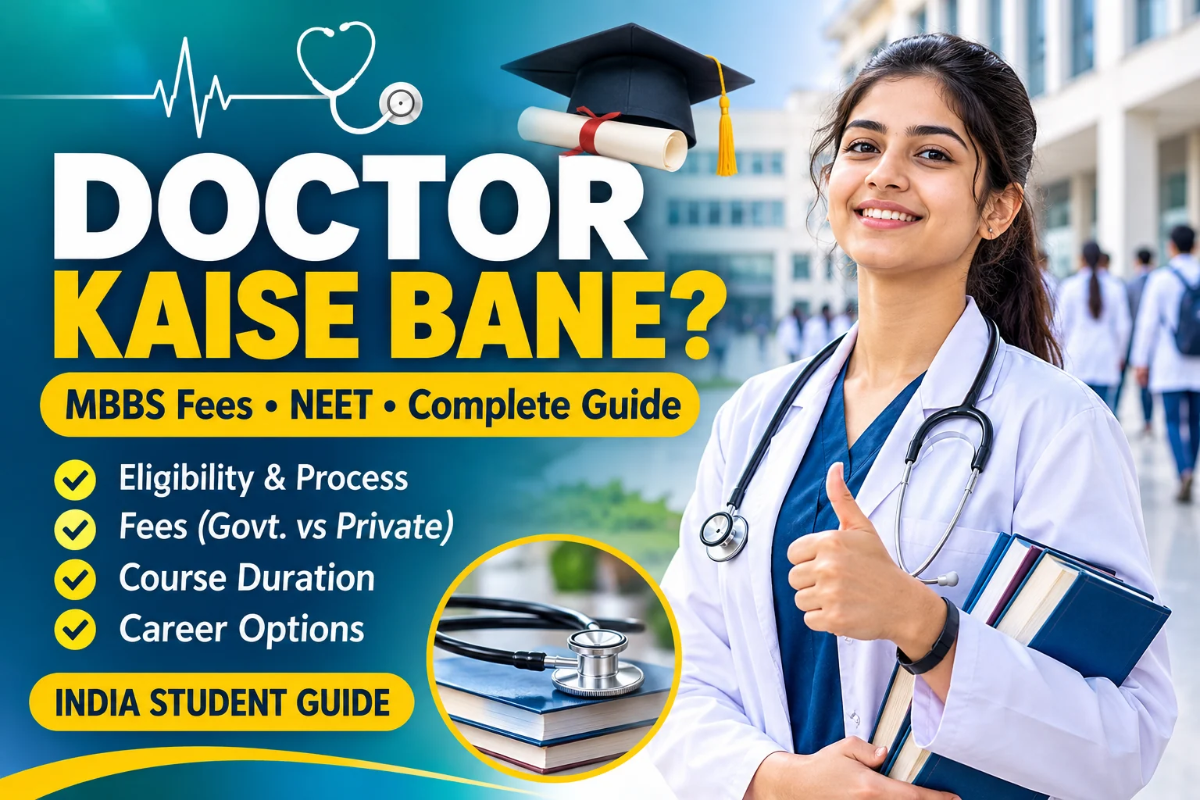
Have you ever dreamed of becoming a doctor? Perhaps your parents want you to become a doctor, or you have always wanted to help people and build a career in healthcare.
But as soon as you start thinking seriously about this career, two questions usually come to mind:
- Doctor banne ke liye kya karna padta hai?
- Doctor banne ke liye kitna paisa lagta hai?
These are genuine questions. Becoming a doctor in India requires dedication, years of education, entrance examination preparation and financial planning.
The good news is that you do not necessarily need to come from a very wealthy family to pursue an MBBS degree. Government medical colleges offer subsidised education, while private medical colleges generally charge substantially higher fees.
In this guide, we will explain everything in simple language, from choosing subjects after Class 10 to clearing NEET, getting admission to a medical college, understanding MBBS fees and eventually becoming a qualified doctor.
Let’s start!
1. Doctor banne ke liye kya karna padta hai?
If you want to become an MBBS doctor in India, you generally need to complete the following steps:
- Complete Class 10.
- Choose the Science stream with Physics, Chemistry and Biology (PCB) in Class 11.
- Complete Class 12 with the required subjects and eligibility.
- Prepare for and qualify NEET-UG.
- Participate in the appropriate medical admission counselling process.
- Secure an MBBS seat in an eligible, recognised medical college.
- Complete 4.5 years of academic MBBS education.
- Complete one year of compulsory rotating medical internship.
- Fulfil the applicable medical registration and licensing requirements.
In simple words, you need to complete your school education, clear the medical entrance examination, study MBBS and complete the compulsory internship before practising independently under the applicable regulations.
2. How to become a doctor after Class 10?
If you are currently studying in Class 10, this is the right time to start planning.
Step 1: Choose the Science stream
After completing Class 10, choose Science with the following subjects:
- Physics
- Chemistry
- Biology
- English
Mathematics may also be selected as an additional subject, depending on your school and academic requirements.
Biology is particularly important for students planning to pursue MBBS.
Step 2: Study Physics, Chemistry and Biology seriously
NEET-UG tests knowledge of Physics, Chemistry and Biology.
Therefore, build a strong understanding of these subjects from Class 11 itself.
Do not focus only on memorising answers. Understand concepts, practise numerical questions and revise regularly.
Step 3: Start preparing for NEET
NEET preparation can be started alongside regular school studies.
A sensible preparation strategy includes:
- Understanding the NCERT syllabus.
- Studying Biology thoroughly.
- Practising Physics numerical problems.
- Learning Chemistry concepts and reactions.
- Solving previous years’ NEET question papers.
- Taking regular mock tests.
- Reviewing mistakes and revising weak topics.
You do not necessarily need expensive coaching to prepare for NEET. Students can also use NCERT textbooks, quality study materials, previous-year papers and online learning resources.
However, disciplined preparation is essential.
3. What are the eligibility requirements to become an MBBS doctor?
Before applying for MBBS admission, students must satisfy the applicable eligibility requirements.
The general requirements include:
| Requirement | Details |
|---|---|
| Educational qualification | Class 12 or equivalent |
| Required subjects | Physics, Chemistry, Biology/Biotechnology and English |
| Entrance examination | NEET-UG |
| Minimum age | 17 years by the prescribed admission-year deadline |
| Admission | Through the applicable counselling process |
The qualifying examination and category-related eligibility requirements are governed by the current National Medical Commission regulations and NEET information bulletin.
Students should check the latest official eligibility rules before applying because examination and admission requirements can be updated.
Official information: https://neet.nta.nic.in/
4. What is NEET and why is it important?
NEET stands for National Eligibility cum Entrance Test.
It is the national entrance examination used for admission to MBBS programmes in India.
The National Testing Agency (NTA) conducts NEET-UG.
Students seeking MBBS admission need to appear for NEET and satisfy the applicable qualifying and admission requirements.
What subjects are included in NEET?
The examination covers:
- Physics
- Chemistry
- Biology (Botany and Zoology)
NEET performance is important because medical college admission depends on factors such as:
- NEET score and rank.
- Candidate category.
- State eligibility and domicile rules, where applicable.
- Available seats.
- College preferences.
- Counselling and seat allotment rules.
Important: Merely qualifying NEET does not guarantee an MBBS seat. Your rank, category, available seats and counselling outcome also matter.
Official website: https://neet.nta.nic.in/
5. Doctor banne ke liye kitna paisa lagta hai?
Now let’s answer the question that many students and parents worry about.
Doctor banne ke liye kitna paisa lagta hai in India?
There is no single fixed amount. The total cost depends mainly on the type of medical college you attend.
The two main options are:
A. Government medical college
Government medical colleges generally offer MBBS education at significantly subsidised tuition fees.
This makes them a more affordable option for many students.
However, the actual cost depends on the state, institution and applicable fee structure.
Your expenses may include:
- Tuition and academic fees.
- Admission and registration charges.
- Hostel accommodation.
- Food and mess expenses.
- Books and study materials.
- Examination fees.
- Transportation and personal expenses.
Some government institutions have relatively low tuition fees, while others may have different fee structures.
B. Private medical college
Private medical colleges generally charge higher tuition fees than government institutions.
The actual fee depends on:
- The medical college.
- State regulations.
- Government or state quota seats.
- Management quota seats, where applicable.
- Deemed university admission category.
- Hostel and other facilities.
Students should not assume that all private colleges charge the same amount.
Government vs private MBBS fees
| Expense | Government college | Private college |
|---|---|---|
| Tuition fee | Generally lower | Generally higher |
| Hostel | Institution-dependent | Institution-dependent |
| Food and mess | Additional expense | Additional expense |
| Books and equipment | Additional expense | Additional expense |
| Admission charges | Applicable | Applicable |
| Total expenditure | Generally more affordable | Can be substantially higher |
Is there a fixed national MBBS fee?
No.
The Ministry of Health and Family Welfare has clarified in Parliament that MBBS fees vary across states and are determined under the applicable state fee regulatory framework.
Government medical college fees are subsidised to improve accessibility.
Therefore, the best way to calculate the actual cost is to check the latest official fee notification of the college and the relevant counselling authority.
An important MBBS fee update for 2026
The National Medical Commission issued a public notice on 7 April 2026 clarifying the academic duration for which MBBS fees may be charged.
The prescribed MBBS programme consists of:
- 4.5 years (54 months) of academic study.
- One year of compulsory rotating medical internship.
The NMC directed medical colleges to charge MBBS course fees only for the prescribed 4.5-year academic duration, rather than charging tuition for the entire five- or five-and-a-half-year period.
Students and parents should carefully examine the latest official fee notification and payment schedule before accepting admission.
What should parents check before paying MBBS fees?
Never compare colleges only by looking at the tuition fee.
Ask for a complete written breakdown of:
- Total academic tuition fee.
- Hostel fee.
- Mess charges.
- Refundable security deposit.
- Admission and registration fees.
- Examination charges.
- Other compulsory charges.
- Payment schedule.
- Refund and withdrawal policy.
- Internship stipend and applicable conditions.
This will help you understand the actual financial commitment.
6. How many years does it take to become a doctor?
A common question among students is:
Doctor banne mein kitne saal lagte hain?
The MBBS programme in India has the following structure:
| Stage | Duration |
|---|---|
| MBBS academic education | 4.5 years |
| Compulsory rotating internship | 1 year |
| Total | 5.5 years |
So, after Class 12, you should generally plan for approximately 5.5 years to complete MBBS and the compulsory internship.
If you want to become a specialist, you may pursue further education after MBBS.
For example:
- MD – Doctor of Medicine.
- MS – Master of Surgery.
- DM – Doctorate of Medicine (super-speciality).
- MCh – Master of Chirurgiae (super-speciality surgical qualification).
- DrNB – Diplomate of National Board Super Speciality.
-
How to become a specialist doctor after MBBS?
If you want to specialise in a particular branch of medicine, you generally need to pursue postgraduate medical education after completing MBBS and the required internship.
Here is the usual pathway:
Step 1: Complete MBBS
Complete 4.5 years of academic study and one year of compulsory rotating internship.
Step 2: Obtain the required medical registration
Fulfil the applicable registration requirements to pursue postgraduate medical education.
Step 3: Qualify for postgraduate admission
Appear for the applicable postgraduate entrance examination, such as NEET-PG, subject to the prevailing admission regulations.
Step 4: Complete MD, MS or an equivalent postgraduate qualification
Depending on your chosen specialisation, you can pursue:
-
MD General Medicine
-
MD Paediatrics
-
MD Dermatology
-
MD Radiodiagnosis
-
MD Anaesthesiology
-
MS General Surgery
-
MS Orthopaedics
-
MS Obstetrics and Gynaecology
-
MS ENT
-
MS Ophthalmology
Most MD/MS programmes have a duration of three years.
Step 5: Pursue super-specialisation (optional)
If you want to become a super-specialist, you can pursue further qualifications such as DM, MCh or DrNB in an eligible speciality.
Examples include:
Super-speciality Area of specialisation DM Cardiology Heart diseases DM Neurology Brain and nervous system DM Medical Oncology Cancer treatment DM Nephrology Kidney diseases MCh Neurosurgery Brain and spine surgery MCh Cardiothoracic Surgery Heart and chest surgery MCh Urology Urinary system and male reproductive health Admission pathways and eligibility depend on the speciality and current regulatory requirements.
How long does it take to become a specialist doctor?
Your educational journey may look like this:
Qualification Approximate duration MBBS 5.5 years, including internship MD/MS Additional 3 years DM/MCh after eligible postgraduate qualification Usually additional 3 years For example, becoming a cardiologist generally involves MBBS followed by MD/DNB in an eligible discipline and then DM/DrNB Cardiology.
Therefore, becoming a super-specialist can take approximately 11.5 years or more after Class 12, depending on the chosen pathway and eligibility.
Remember: You do not have to become a specialist to begin your medical career. MBBS is the basic medical qualification, while postgraduate and super-speciality education allow you to develop expertise in particular branches of medicine.
Suggested official references for this section
-
National Medical Commission: https://www.nmc.org.in/
-
National Board of Examinations in Medical Sciences: https://natboard.edu.in/
-
NEET-PG information: https://natboard.edu.in/
-
Medical counselling information: https://mcc.nic.in/
Editorial note for publication: Have a qualified medical education professional verify the current entrance examination and registration rules before publishing. Examination names, eligibility and admission pathways can change.
-